Menstrual Cycle Flare Tracker: What to Log When Symptoms Change
A practical guide to tracking cycle-related flares, POTS symptoms, fibromyalgia pain, fatigue, brain fog, GI symptoms, medications, and appointment questions.

Zebra
For invisible chronic illness
Symptom Tracking
When POTS, EDS, and MCAS symptoms overlap, the hard part is not just having more symptoms. It is trying to explain dizziness, pain, fatigue, flushing, GI symptoms, medication changes, triggers, and function changes as one readable history instead of separate fragments.
When POTS, EDS or hEDS, and MCAS symptoms overlap, the hard part is not just having more symptoms. It is trying to explain dizziness, pain, fatigue, flushing, GI symptoms, medication changes, triggers, and function changes as one readable history instead of separate fragments.
This is why overlap tracking needs a different shape from a normal symptom diary. A list of symptoms can become too long to use. A better record shows what changed, what happened nearby, and what made daily life harder.
Research and patient-education sources describe overlap among hypermobility, POTS or dysautonomia, and mast-cell-related symptoms, while also noting that diagnosis is complex and should stay with clinicians. The point of tracking is not to prove a diagnosis. The point is to bring a clearer story into care.
On overlap days, start by naming the main cluster.
For example:
You do not need to track every sensation perfectly. The first goal is to preserve enough of the pattern that you do not have to rebuild it from memory before the appointment.
Overlap symptoms are easier to review when each entry includes timing.
Useful timing notes include:
This does not mean the nearby event caused the symptoms. It simply keeps the context available for discussion.
For POTS and dysautonomia tracking, orthostatic context can be especially useful: what happened lying down, sitting, standing, or after being upright for longer.
When several conditions overlap, medication and supplement notes can become scattered quickly.
Track:
The value is not only the list. The value is the timeline. If symptoms changed near a medication change, you can bring that context without trying to remember the sequence later.
For a deeper version, read How to Track Medication Changes During a Flare.
Symptoms can sound abstract until you explain what they changed.
Instead of only writing “fatigue,” add examples like:
This helps turn a long symptom list into a care conversation. Functional impact answers the practical question: what is this doing to your life?
For overlap flares, try this short format:
This format works even if you only fill out part of it. A partial entry from a bad day is usually more useful than a perfect entry that never happens.
Before a specialist visit, turn the timeline into a short summary:
If you need the appointment-specific version, use the Doctor Appointment Symptom Checklist or How to Organize Your Health History for a Doctor Visit.
The Ehlers-Danlos Society notes that hEDS can affect many body systems and discusses mast cell activation syndrome symptoms such as allergic responses, GI symptoms, and bladder issues in its hEDS education page. PubMed and PMC sources also describe clinical interest in the relationship among hEDS, POTS, and MCAS, while emphasizing that definitions and evidence can be complex.
Helpful background:
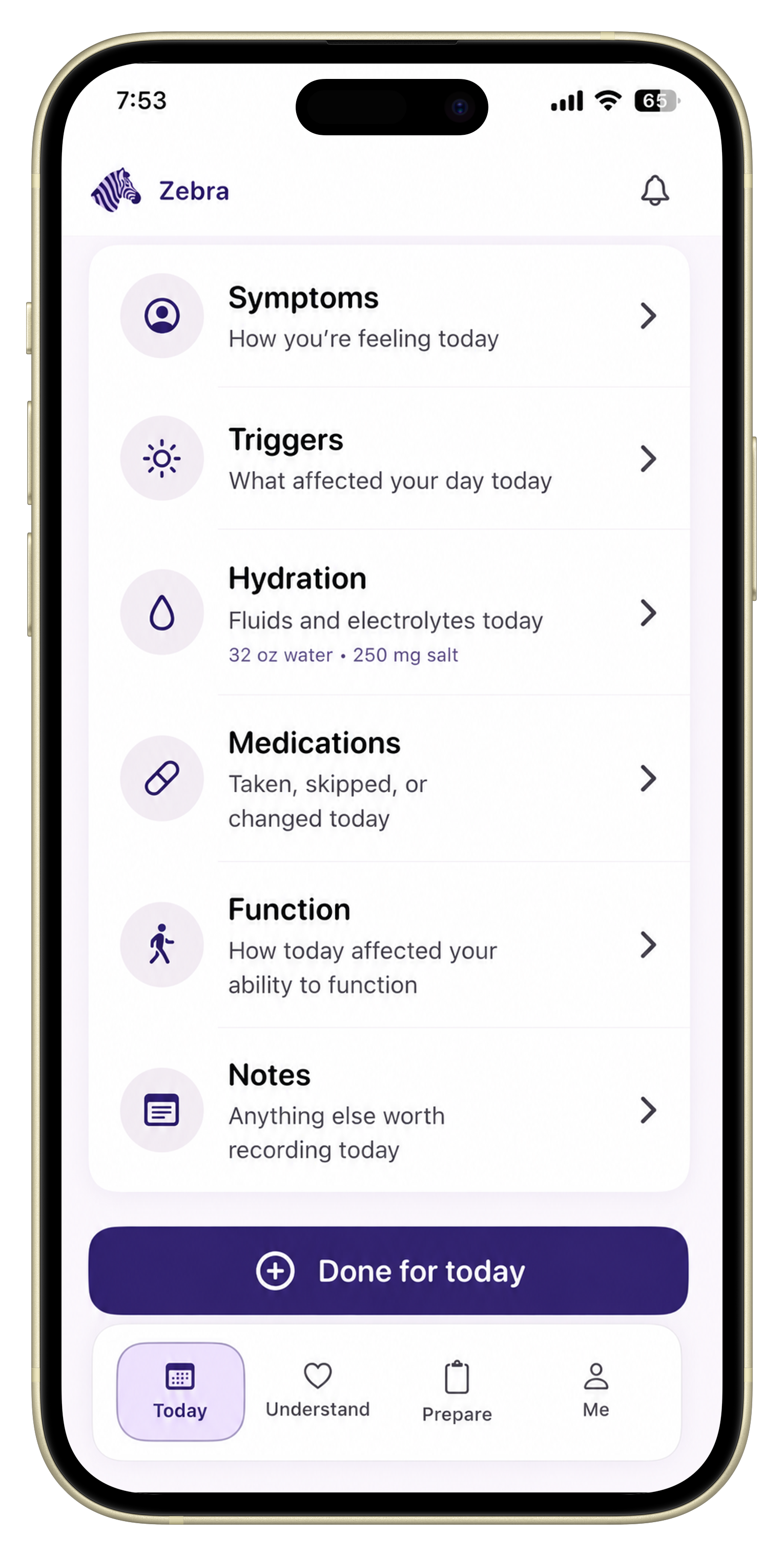
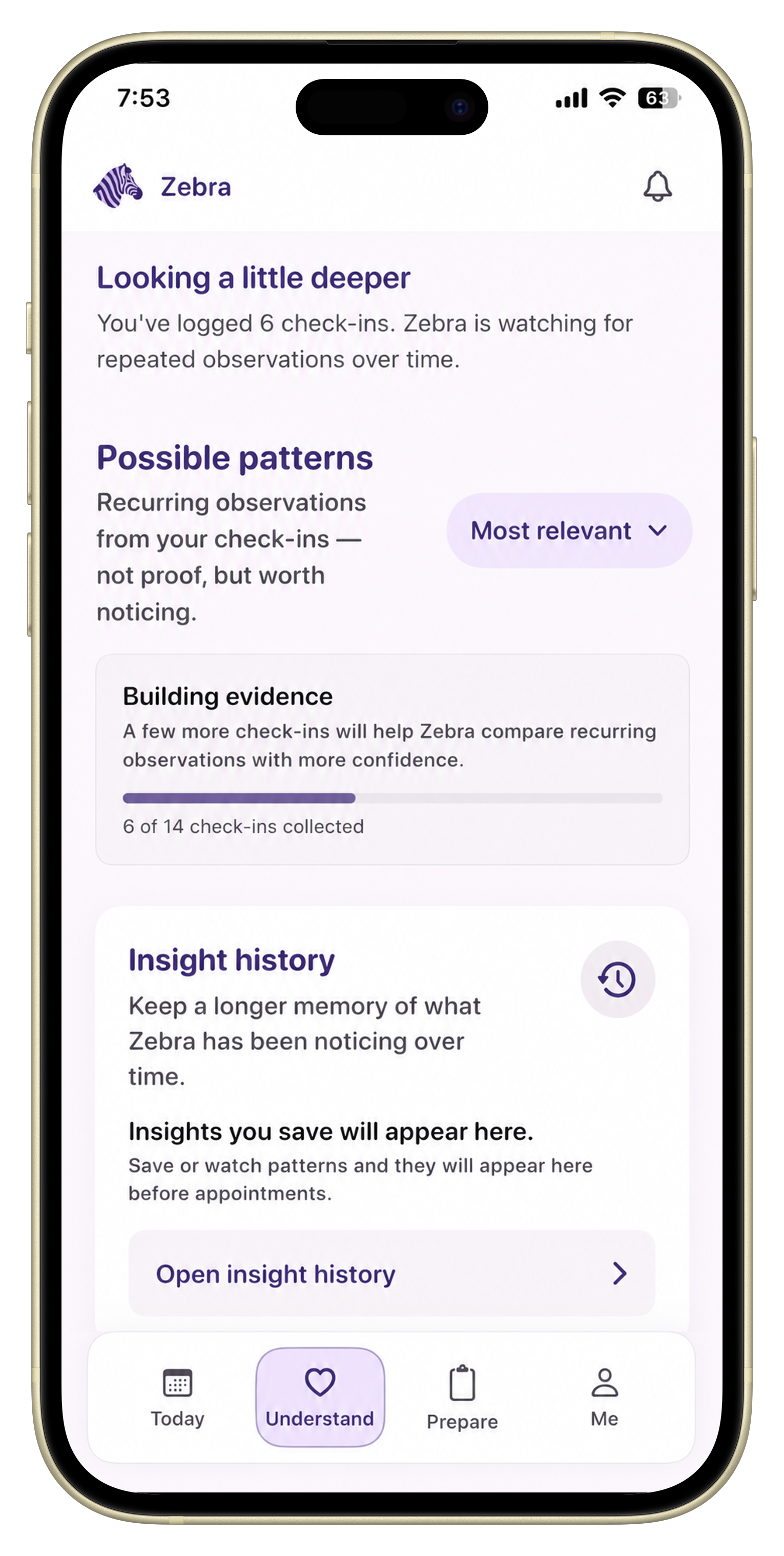
Zebra is built for the tracking problem that overlap creates: symptoms, flares, orthostatic vitals, medications, hydration, salt, triggers, notes, and appointment questions living in one timeline.
It does not diagnose POTS, EDS, MCAS, or any condition. It helps you keep patient-entered history organized enough to review before a doctor visit.
Yes. Some people have diagnoses or symptoms involving POTS, EDS or hEDS, and MCAS at the same time, but tracking overlap does not replace clinical interpretation.
Track the main symptom cluster, timing, possible triggers, orthostatic context, medication changes, functional impact, and questions for the appointment.
No. Track triggers as context. A note that heat, food, standing, stress, infection, medication change, or activity happened near a flare can be useful without claiming cause.
Use a short daily structure: what changed, how bad it was, what was nearby, and what it stopped you from doing.
No. Zebra helps organize patient-entered history for appointments. It does not diagnose, treat, or replace medical care.
Put this into practice
Use Zebra to keep overlapping symptoms, triggers, medications, orthostatic context, and appointment questions in one timeline.
Download ZebraKnowledge hub
Keep exploring
A practical guide to tracking cycle-related flares, POTS symptoms, fibromyalgia pain, fatigue, brain fog, GI symptoms, medications, and appointment questions.
A practical guide to tracking sick-day POTS flares, infection symptoms, fever, hydration, salt, medication timing, heart rate, dizziness, fatigue, recovery, and doctor-ready summaries.
A practical guide to tracking post-meal symptoms, nausea, bloating, reflux, bowel changes, heart rate, dizziness, hydration, salt, medication timing, and functional impact.
A practical guide to tracking morning POTS symptoms, getting out of bed, hydration, salt, breakfast, medication timing, heart rate, blood pressure, dizziness, brain fog, recovery, and doctor-ready summaries.