Doctor Appointment Symptom Checklist
A practical symptom checklist for preparing clearer notes before a doctor, specialist, or cardiology appointment.

Zebra
For invisible chronic illness
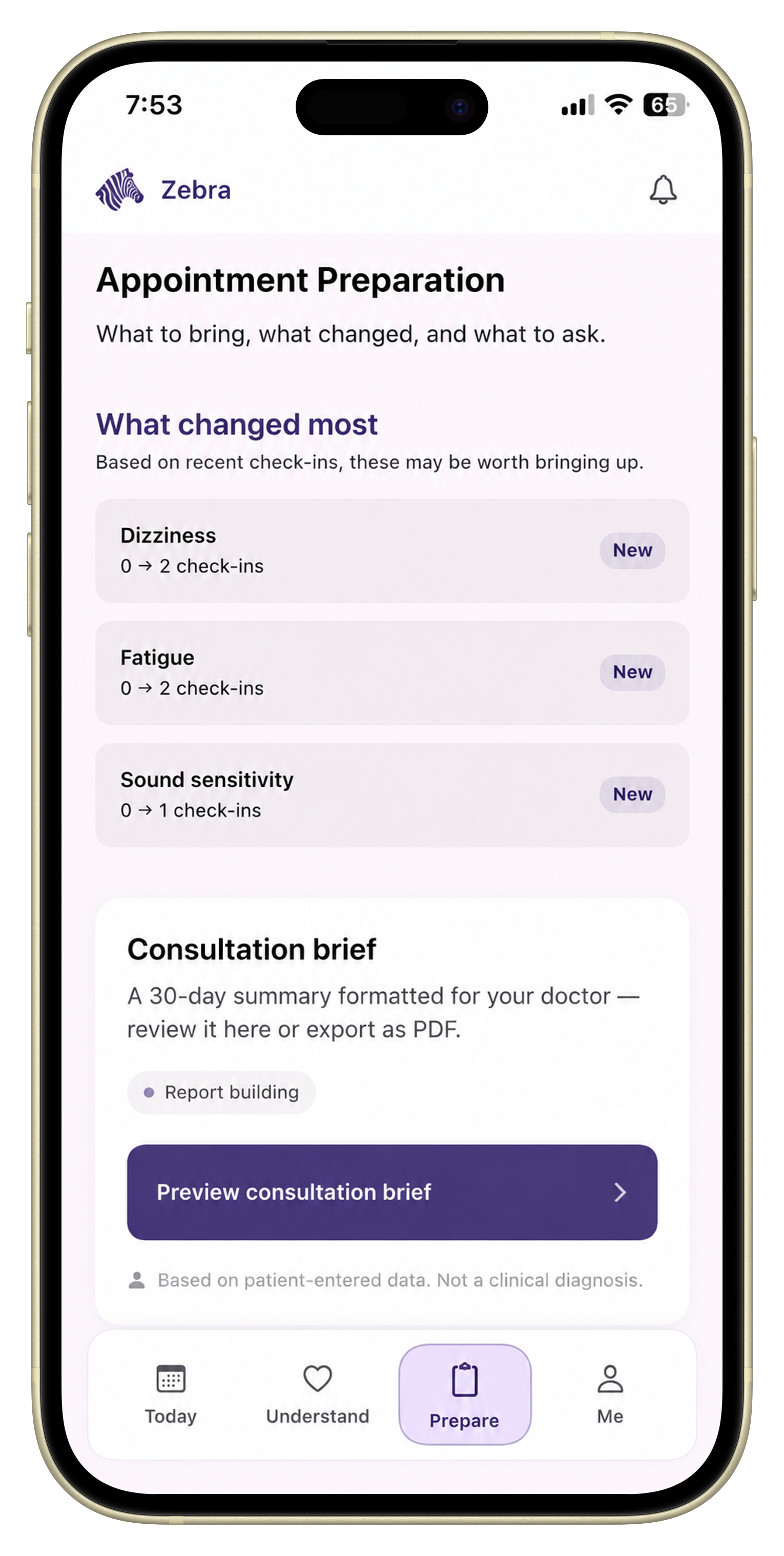
Appointment Preparation
A baseline is not a fixed number or a permanent verdict on your body. It is simply what counts as usual for you right now, so you and a specialist can both recognize when something has genuinely changed. Setting one does not take a perfect month of notes. It takes a short, honest window of tracking and a clear way to compare it later.
A baseline is not a fixed number or a permanent verdict on your body. It is simply what counts as usual for you right now, so you and a specialist can both recognize when something has genuinely changed. Setting one does not take a perfect month of notes. It takes a short, honest window of tracking and a clear way to compare it later.
For people managing POTS, dysautonomia, EDS, fibromyalgia, or overlapping conditions, this matters more than it sounds. Symptoms already fluctuate day to day. Without a baseline, a bad week and a real decline can look identical from memory, which makes it hard to know whether to worry, wait, or bring it to a specialist. A baseline gives you something steadier to compare against than “I feel like this is getting worse.”
A specialist rarely has time to reconstruct your history from scratch in one visit. What they can use quickly is a comparison: this is what was usual, this is what is happening now, this is what changed.
A baseline helps with three specific problems:
None of this requires a perfect history. It requires a baseline that is honest enough to be useful.
Keep this narrower than it sounds. A baseline is built from a few consistent categories, not exhaustive daily tracking.
List the symptoms that show up regularly for you, not every sensation you have ever had. For many people managing POTS or dysautonomia, this might include dizziness, palpitations, fatigue, or brain fog. For EDS or fibromyalgia, it might include pain, joint instability, or unrefreshing sleep. Track how often each one shows up and roughly how severe it usually is.
This is often more useful than a symptom list on its own. Track what you can typically do on an ordinary day: work or school hours, a shower, a short walk, cooking a meal, a full social plan. Function is what shows the real cost of a symptom, and it is also what makes a later shift easy to describe.
A baseline is not only your best days. Include at least one representative flare or hard day, since that is part of your usual pattern too. Leaving out the bad days makes a real decline harder to see later, because you will be comparing a future bad stretch only against your good days.
Note current medications, supplements, and routines, including hydration or salt habits if relevant. If something changes later, you want to know whether a shift lines up with a treatment change or looks independent of it.
A practical default is one to two weeks of reasonably consistent tracking. That is usually enough to capture a typical range, including a difficult day, without turning tracking into a second job.
If your symptoms are highly variable, closer to two to three weeks can help, but do not wait for a perfect or representative month. A short, real window is more useful than an indefinitely postponed complete one.
This is often the hardest judgment call, and it is worth being specific about.
A hard stretch or flare usually:
A baseline shift is more likely when:
Neither pattern confirms a diagnosis or a cause on its own. What they do is give you and a specialist a shared, specific way to talk about what changed, instead of relying on memory under pressure in the appointment.
If you are short on energy, this structure is enough:
Zebra’s doctor report is built to hold this same comparison, so you are not rebuilding it from memory the night before an appointment.
If your baseline only reflects your best days, an ordinary flare will look like an emergency later, and a real decline will be harder to prove.
There is no perfectly stable window free of any symptoms. Start tracking your actual pattern, flares included, rather than waiting for one that does not exist.
A single hard stretch is data, not a conclusion. Give it time to either resolve or hold before treating it as a new baseline.
Bodies change for many reasons, and a shift is not automatically a sign that something was overlooked. It is simply worth documenting and discussing.
On harder days, a baseline can still be built from very little:
That is enough to compare against later. The goal is a real reference point, not a complete one.
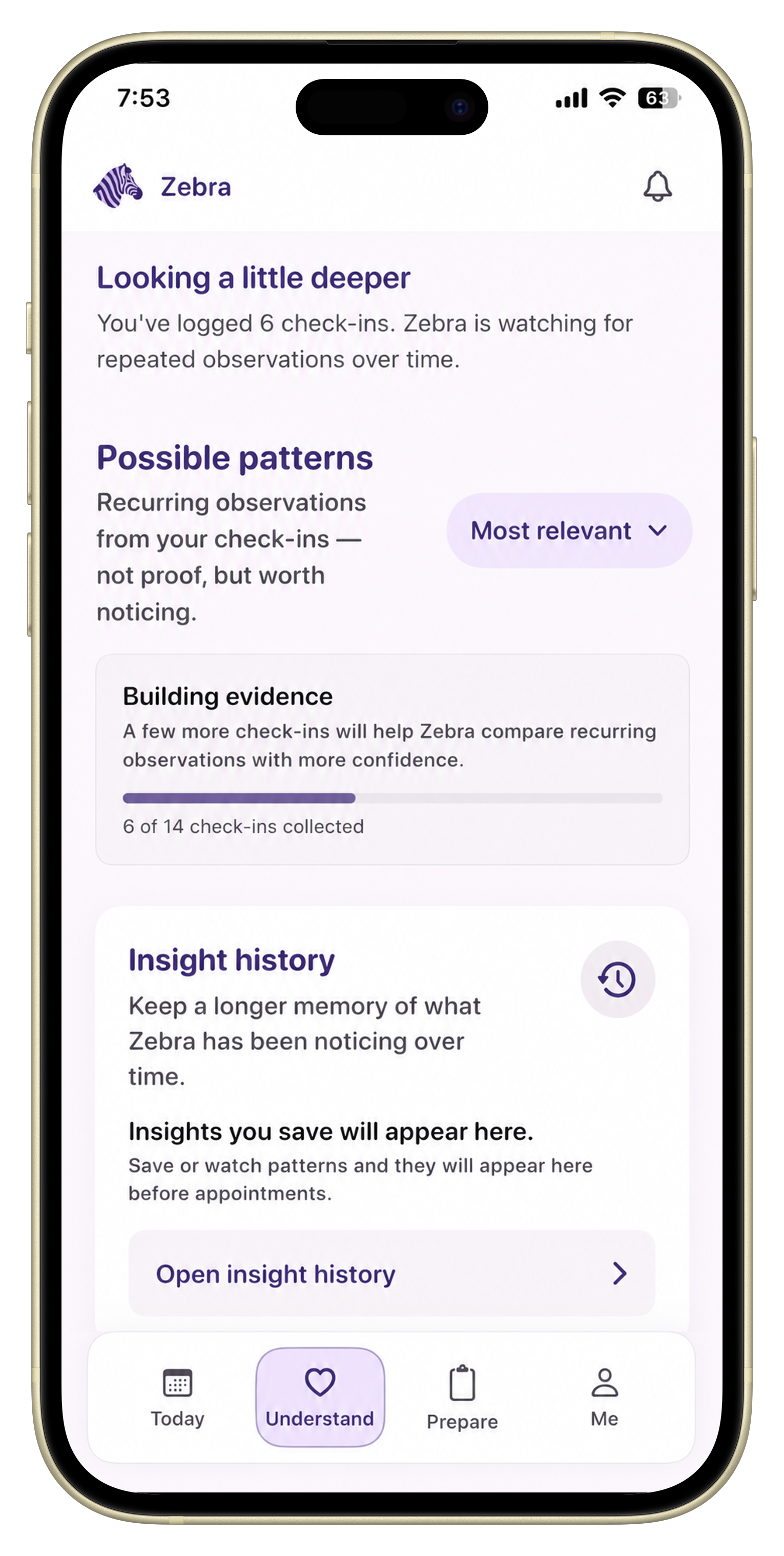
Zebra is built around the idea that your baseline is not a one-time setup step. It is something worth revisiting as your history grows.
Instead of trying to remember what “normal” used to feel like, Zebra can help you keep:
so that a real shift shows up clearly when you look back, instead of blending into the noise of day-to-day variation.
Zebra does not diagnose a shift or tell you what caused it. It helps you document your baseline clearly enough that you and a specialist can look at the same comparison together.
A symptom baseline is what counts as usual for you right now: your typical symptoms, severity, and functional capacity on an ordinary day. It is a comparison point, not a diagnosis or a fixed score.
A short, honest window is usually enough. One to two weeks of consistent tracking, including at least one bad day, gives a specialist something real to compare against.
Yes. Baselines shift over time, for better or worse. Noticing a shift is not a failure of your old baseline. It is useful information about where things stand now.
A single bad day or a short flare usually returns to your prior usual. A shift is more convincing when a new level of symptoms or function holds for more than a couple of weeks, not just a few days.
No. Missing a day does not erase your baseline. What matters is a reasonably consistent pattern over the tracking window, including both ordinary and difficult days.
Track the current pattern for a short window anyway. A specialist responds better to a comparison between a documented old baseline and a documented current one than to a description from memory alone.
Put this into practice
Download Zebra to track your usual symptoms and function, so a real shift is easy to see and easy to show a specialist.
Download ZebraKnowledge hub
Keep exploring
A practical symptom checklist for preparing clearer notes before a doctor, specialist, or cardiology appointment.
A practical guide to choosing a symptom tracker that helps before specialist and follow-up appointments.
Learn what to track before a specialist appointment, including symptoms, flares, medications, function changes, and your top questions.
A practical framework for tracking how symptoms affect daily life before a doctor appointment.